How to Get ISO 9001 Certification in Canada: Step by Step Guide (2026)
This guide explains what ISO 9001 is, who can become certified, the step-by-step certification process, typical costs and timelines, the difference between accredited and non-accredited certification, and the information organizations should prepare before requesting a quotation.
Current-version note: As of July 2026, ISO 9001:2015 together with ISO 9001:2015/Amd 1:2024 remains the published certification basis. ISO/FDIS 9001 is the final draft of the next edition and is expected to replace ISO 9001:2015 in September 2026.
Contents
- What Is ISO 9001?
- Who Can Obtain ISO 9001 Certification?
- Benefits of ISO 9001 Certification
- How to Get ISO 9001 Certification in Canada
- How Much Does ISO 9001 Certification Cost in Canada?
- How Long Does ISO 9001 Certification Take?
- Accredited vs Non-Accredited Certification
- Why Choose ACS Canada Certification?
- Frequently Asked Questions
- Conclusion and Next Steps
What Is ISO 9001?
ISO 9001 specifies requirements for establishing, implementing, maintaining, and continually improving a Quality Management System (QMS). A QMS is the organized framework of policies, processes, responsibilities, controls, objectives, and records used to manage quality and consistently deliver products and services.
ISO 9001 does not prescribe one fixed operating method. Instead, it sets requirements that each organization applies according to its size, activities, risks, complexity, legal obligations, and business objectives.
What does ISO stand for?
ISO is the International Organization for Standardization, an independent, non-governmental international organization that develops standards through cooperation among national standards bodies and subject-matter experts.
ISO 9000 and ISO 9001: What is the difference?
The ISO 9000 family covers quality management. ISO 9000 explains fundamental concepts, principles, and vocabulary. ISO 9001 contains the auditable requirements used for third-party certification. An organization is therefore certified to ISO 9001, not generally to the entire ISO 9000 family.
ISO 9001:2015 and Amendment 1:2024
ISO 9001:2015 is the current published edition used for certification. Its auditable requirements are contained in Clauses 4 through 10: context of the organization, leadership, planning, support, operation, performance evaluation, and improvement.
The 2024 climate-action amendment requires organizations to determine whether climate change is a relevant issue for their QMS and whether interested parties have climate-related requirements. The amendment applies alongside ISO 9001:2015.
What is ISO 9001:2026?
The revised edition is currently at the Final Draft International Standard stage, identified as ISO/FDIS 9001. It should not be presented as a published certification standard until ISO formally releases it. Organizations should continue to be audited against ISO 9001:2015 and the 2024 amendment until the new edition is officially published.
Publishing caution: Do not advertise an organization as certified to ISO 9001:2026 before the new edition is officially published and applicable.
Is ISO 9001 a product certification standard?
No. ISO 9001 certification applies to an organization’s defined management-system scope. It does not mean that every individual product has been independently tested, approved, or certified. Product certification, testing, and regulatory approval are separate activities.
Is ISO 9001 mandatory in Canada?
ISO 9001 certification is generally voluntary. It may nevertheless become commercially or contractually necessary when required by customers, tender documents, government or municipal procurement programs, prime contractors, international buyers, vendor-registration systems, or supply-chain qualification programs.
Who Can Obtain ISO 9001 Certification?
ISO 9001 can be applied by organizations of any size and in almost any sector. There is no minimum employee count, revenue level, or number of years in business.
Manufacturing: production control, purchasing, inspection, testing, equipment, suppliers, and nonconforming outputs.
Construction and engineering: project planning, design control, subcontractors, site activities, inspections, and document control.
Technology and software: development, project delivery, change management, customer support, and service quality.
Food and beverage: quality controls that may be integrated with ISO 22000 food-safety management.
Healthcare and professional services: service consistency, competence, communication, confidentiality, and customer satisfaction.
Transportation and logistics: dispatching, warehousing, delivery performance, maintenance, and complaints.
Education and training: program delivery, instructor competence, evaluation, and administrative processes.
Government and non-profit organizations: service consistency, accountability, performance, and stakeholder confidence.
Can a small business or start-up be certified?
Yes. A small business can operate a concise and practical QMS. One person may perform several roles, and the documented information may be much simpler than in a large organization. The key requirement is evidence that processes are defined, implemented, controlled, monitored, evaluated, and improved.
Can an individual be ISO 9001 certified?
ISO 9001 organizational certification applies to a company or organization’s QMS. Individuals may complete requirements, internal-auditor, implementation, or lead-auditor training, but personal training certificates are different from organizational ISO 9001 certification.
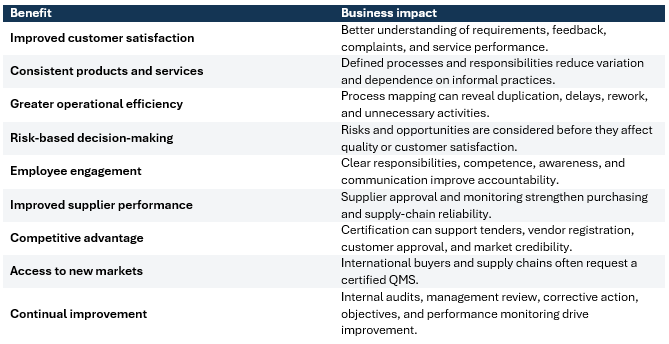
Benefits of ISO 9001 Certification
ISO 9001 certification is more than a certificate for display. When the QMS is genuinely used, it can improve business discipline, customer confidence, operational control, and decision-making.
How to Get ISO 9001 Certification in Canada: Step-by-Step Process
The certification journey varies by organization, but the following steps form the typical pathway for Canadian organizations.
Step 1-Understand the standard
Management and key personnel should understand customer focus, process management, risk-based thinking, leadership, performance evaluation, and improvement.
Step 2 -Conduct a gap assessment
Compare current practices with ISO 9001 requirements and identify missing controls, records, or documented information.
Step 3-Define the scope and processes
Establish the products, services, locations, departments, and processes that will be covered by certification.
Step 4-Develop and implement the QMS
Prepare practical policies, process controls, objectives, risk assessments, procedures, forms, and records appropriate to the organization.
Step 5-Train employees
Ensure personnel understand the quality policy, responsibilities, procedures, required records, and methods for reporting problems.
Step 6-Operate the QMS and collect evidence
Use the system during normal operations and retain records such as inspections, training, supplier evaluations, customer feedback, and corrective actions.
Step 7-Conduct an internal audit
Evaluate conformity and implementation, record nonconformities and opportunities for improvement, and complete corrective actions.
Step 8 -Hold management review
Top management reviews performance, objectives, audit results, customer feedback, risks, resources, corrective actions, and improvement opportunities.
Step 9-Complete the Stage 1 audit
The certification body evaluates scope, documentation, readiness, internal audit, management review, and preparedness for Stage 2.
Step 10-Complete the Stage 2 audit
The auditor evaluates actual implementation through interviews, observation, record sampling, and process review.
Step 11- Close nonconformities and receive certification
The organization submits corrections and corrective actions. Following successful technical review and certification decision, the certificate is issued.
Step 12-Maintain certification
Surveillance audits are normally conducted during the certification cycle, followed by recertification before the cycle expires.
Common mistakes that delay certification
- Creating excessive documentation that employees do not use.
- Scheduling Stage 2 before sufficient implementation records exist.
- Completing an internal audit that does not cover the full QMS.
- Failing to hold a meaningful management review.
- Closing corrective actions without investigating root cause or verifying effectiveness.
- Using an inaccurate or artificially narrow certification scope.
- Not identifying all sites, shifts, outsourced processes, or relevant personnel during application review.
How Much Does ISO 9001 Certification Cost in Canada?
There is no universal fixed price for ISO 9001 certification. The quotation depends on employee count, scope, number of sites, shifts, complexity, design activities, outsourced processes, required auditor competence, audit method, and travel requirements. Accredited certification audit time must be determined through an appropriate application and contract review.
What affects the price?
- Number of personnel included in the certification scope
- Scope and complexity of products, services, and processes
- Number of sites, branches, warehouses, or project locations
- Number of shifts and seasonal activities
- Design and development responsibilities
- Industry risk and required technical competence
- On-site, remote, or hybrid audit arrangements
- Travel and accommodation requirements
- Accredited or non-accredited certification pathway
Certification cost vs implementation cost
Certification cost is the fee charged for independent audit and certification activities. Implementation cost is the organization’s internal or external cost of developing and operating the QMS, including training, staff time, gap assessment, documentation, calibration, software, and process improvement.
To protect impartiality, the certification function should remain independent from management-system consultancy for the same client.
Three-year budget example
Using the starting fees above, a qualifying small organization may budget approximately CAD $4,700 for initial accredited certification plus two surveillance audits, before taxes, travel, additional services, and recertification.
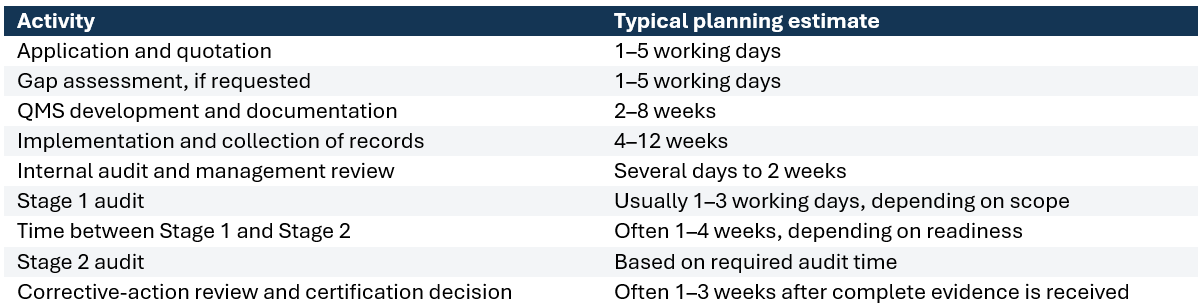
How Long Does ISO 9001 Certification Take?
A well-prepared small organization may complete certification within several weeks. Many small and medium-sized organizations should plan for approximately two to six months from initial preparation to certification. Complex, multi-site, regulated, or newly established organizations may require longer.
What commonly causes delays?
- Incomplete documentation or unclear certification scope
- Insufficient evidence that the QMS has been used
- Missing internal audit or management review records
- Unresolved nonconformities
- Late corrective-action submissions
- Unidentified sites, shifts, or outsourced processes
- Auditor scheduling, technical-expert availability, or travel limitations
Can the audit be conducted remotely?
Application review, document review, interviews, electronic record sampling, and some Stage 1 activities may be conducted remotely when appropriate. Manufacturing, construction, warehousing, laboratory, and other activities requiring physical observation may require an on-site or hybrid audit. Remote auditing does not automatically reduce the required audit duration.
Accredited vs Non-Accredited ISO 9001 Certification
The choice between accredited and non-accredited certification should be based on the intended use of the certificate, not price alone.
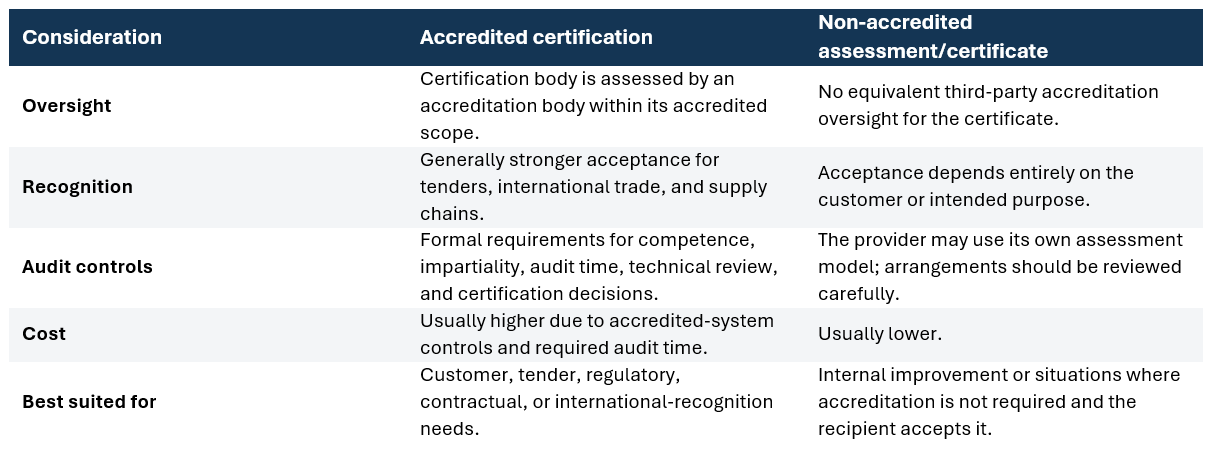
Questions to ask before selecting a certificate
- Does the customer or tender require accredited certification?
- Is ISO 9001 included in the certification body’s accredited scope?
- Does the requested industry or technical sector fall within that scope?
- Who will be named as the certification body on the final certificate?
- Can the certificate be verified through the applicable certification or accreditation system?
- Are the full three-year fees, surveillance arrangements, and travel costs clear?
Why Choose ACS Canada Certification?
Choosing the right certification partner affects audit quality, scheduling, communication, and certificate acceptance. ACS Canada Certification supports organizations through application review, audit planning, Stage 1, Stage 2, surveillance, and recertification.
Accredited certification pathway
ACS Canada states that accredited ISO 9001 certification is delivered through ACS W3 Certification Body under IAS accreditation within the applicable accredited scope.
Canadian service and communication
The team is headquartered in British Columbia and supports organizations across Canada.
Practical audit approach
Audits focus on actual process implementation, objective evidence, risks, performance, corrective actions, and improvement—not unnecessary paperwork.
On-site, remote, and hybrid planning
Audit methods may be considered according to process type, risk, technology, and applicable certification requirements.
Support for small and medium-sized organizations
Certification planning and quotations are tailored to organization size, scope, locations, shifts, and complexity.
Integrated management-system audits
ISO 9001 may be integrated with standards such as ISO 14001, ISO 45001, ISO 22000, ISO 13485, and ISO/IEC 27001 when appropriate.
Transparent process
Clients receive a defined pathway covering application, quotation, audits, corrective actions, certification decision, surveillance, and recertification.
Verification recommendation: Before signing a contract, confirm the requested standard, technical sector, and certificate type are covered by the applicable accreditation scope and meet your customer or tender requirements.
Frequently Asked Questions About ISO 9001 Certification in Canada
1. What is ISO 9001 certification?
It confirms that an organization’s defined Quality Management System has been independently audited against ISO 9001 requirements. It is management-system certification, not product approval.
2. Who issues ISO 9001 certificates?
ISO publishes the standard but does not audit companies or issue certificates. Independent certification bodies perform audits and make certification decisions.
3. Is ISO 9001 mandatory in Canada?
It is generally voluntary, but it may be required by a customer, contract, tender, vendor-registration program, or supply chain.
4. Can a small business or start-up be certified?
Yes. The organization needs a practical QMS and enough implementation evidence for the auditor to assess its effectiveness.
5. How much does certification cost?
Cost depends on employee count, scope, sites, shifts, complexity, audit duration, accreditation needs, and travel. A formal application review is required for an accurate quotation.
6. How long does certification take?
A prepared small organization may complete the process within several weeks; many organizations should plan for two to six months.
7. What is the difference between Stage 1 and Stage 2?
Stage 1 evaluates scope, documentation, readiness, internal audit, and management review. Stage 2 evaluates actual implementation through interviews, observation, and record sampling.
8. Is a quality manual required?
ISO 9001:2015 does not universally require a document titled Quality Manual. The organization must maintain sufficient documented information to operate its processes and demonstrate conformity.
9. Are internal audit and management review required?
Yes. Both are core QMS requirements and should be completed before the organization is considered ready for certification.
10. What happens if the auditor finds a nonconformity?
The organization must correct the issue, investigate the cause, implement corrective action, and submit evidence. Certification may be delayed until required actions are accepted.
11. Can the audit be remote?
Some activities may be remote, but processes requiring physical observation may need an on-site or hybrid audit.
12. How long is the certificate valid?
Certification is normally managed through a three-year cycle, subject to successful surveillance audits and timely recertification.
13. What is accredited certification?
It is certification provided by a certification body that has been assessed by an accreditation body for the applicable scope, competence, impartiality, and certification controls.
14. Can ISO 9001 be integrated with other standards?
Yes. It can be integrated with ISO 14001, ISO 45001, ISO 22000, ISO/IEC 27001, and other compatible management-system standards.
15. Which version applies in 2026?
Until the revised edition is officially published and transition arrangements are announced, ISO 9001:2015 with Amendment 1:2024 remains the published certification basis.
Conclusion and Next Steps
ISO 9001 certification can strengthen process consistency, customer confidence, risk management, supplier control, performance evaluation, and continual improvement. The most effective certification projects begin with a clear scope, a practical QMS, trained personnel, sufficient implementation records, a complete internal audit, and management review.
Organizations should select a certification pathway that meets their actual customer, contractual, tender, and international-recognition needs.
Authoritative References
- ISO 9001:2015 – Quality management systems — Requirements
- ISO/FDIS 9001 – Expected revised edition
- ISO 9001:2015/Amd 1:2024 – Climate action changes
- ISO 9000 family – Quality management
- ACS Canada ISO 9001 certification information
Ready to Begin Your ISO 9001 Certification Project?
Contact ACS Canada Certification for an initial consultation and a customized quotation
based on your organization’s size, scope, locations, activities, and certification objectives.